
 By onlinenews24seven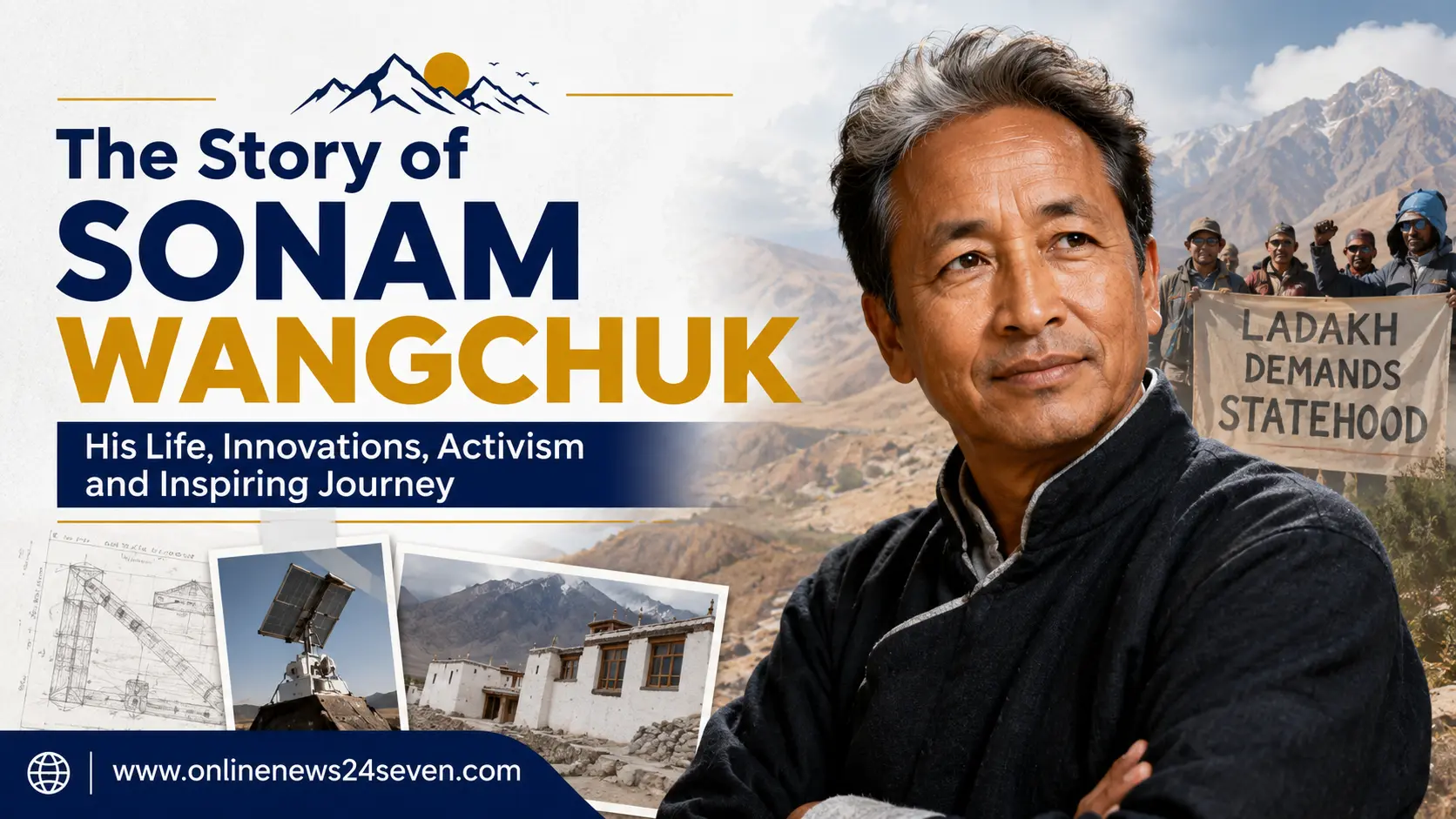
Sonam Wangchuk is an Indian engineer, education reformer, environmental innovator and social activist whose work has transformed the way many people view education and sustainable development in the Himalayan region.
From helping students who had been labelled as failures to developing artificial glaciers for water conservation, Wangchuk’s journey has been shaped by one central belief: education should prepare people to solve the problems around them.
Born in a remote village in Ladakh, he experienced the difficulties of an education system that did not reflect the language, culture or everyday realities of local children. Those early experiences later inspired him to create alternative learning institutions and practical environmental solutions.
Sonam Wangchuk: Age, Education and Personal Details
| Category | Details |
| Full name | Sonam Wangchuk |
| Born | 1966 |
| Age | 59 years as of July 2026 |
| Birthplace | Ulaytokpo, Ladakh, India |
| Nationality | Indian |
| Profession | Engineer, education reformer, innovator and environmental activist |
| Engineering education | Mechanical Engineering from the Regional Engineering College, Srinagar, now known as NIT Srinagar |
| Further studies | Studied earthen architecture at CRAterre in Grenoble, France |
| Organisation founded | Students’ Educational and Cultural Movement of Ladakh, or SECMOL |
| Higher-education initiative | Himalayan Institute of Alternatives, Ladakh, or HIAL |
| Best-known innovation | Ice Stupa artificial glaciers |
| Major award | Ramon Magsaysay Award, 2018 |
| Other recognition | Rolex Award for Enterprise, 2016 |
| Main areas of work | Education reform, water conservation, sustainable architecture and environmental advocacy |
Wangchuk was born in 1966 and was described as 59 years old in July 2026. He grew up in Ulaytokpo, a remote Ladakhi village, and later trained as a mechanical engineer.
Sonam Wangchuk’s Hunger Strike Over the NEET Paper Leak
In June 2026, Sonam Wangchuk extended his activism beyond Ladakh and joined students protesting against alleged irregularities in India’s examination system. On 28 June, he began an indefinite hunger strike at Jantar Mantar in New Delhi in solidarity with the youth-led Cockroach Janta Party movement.
The protest was triggered by allegations surrounding the NEET-UG paper leak and other examination failures affecting millions of students. Wangchuk supported demands for wider examination reforms and called for Union Education Minister Dharmendra Pradhan to resign and accept responsibility for the crisis.
Wangchuk argued that India could not achieve its ambition of becoming a developed country without strengthening its education system. According to him, the resignation of the education minister would represent the first step towards accountability and meaningful reform.
As his fast continued, Wangchuk’s health deteriorated. On 18 July 2026, the authorities moved him from the protest site to hospital on the 21st day of his hunger strike. Police said the decision followed medical advice and a Delhi High Court direction, while Wangchuk had reportedly expressed his wish not to be hospitalised. Doctors described him as weak and dehydrated and warned of the risk of dangerously low potassium levels.
Despite being hospitalised, Wangchuk continued his fast. On 23 July, the 25th day of his protest, he said he had lost approximately 11 kilograms and had begun losing muscle mass. He offered to end the hunger strike if the central government gave an unequivocal assurance that peaceful young protesters involved in the Sansad Chalo march would not face FIRs, harassment or other punitive action.
Wangchuk’s participation gave the student movement wider national attention. It also connected his long-standing work as an education reformer with a broader demand for transparency, accountability and fairness in India’s competitive examination system.
Early Life in Ladakh
Sonam Wangchuk spent the early years of his childhood in a remote village where formal educational facilities were limited. His mother initially taught him in his native Ladakhi language.
When he later attended school outside his village, he faced difficulties because lessons were delivered in languages he did not fully understand. His inability to respond was reportedly mistaken for a lack of intelligence.
This experience had a lasting influence on him. Wangchuk began to understand that children could be intelligent and capable but still perform poorly when the education system ignored their language, environment and cultural background.
Sonam Wangchuk’s Education
Wangchuk studied Mechanical Engineering at the Regional Engineering College in Srinagar, which is now known as the National Institute of Technology Srinagar.
While studying engineering, he conducted coaching classes in subjects such as English and mathematics. The classes attracted a large number of students and helped him recognise that many Ladakhi learners were failing examinations not because they lacked ability, but because their school education had not prepared them properly.
He later pursued studies connected with earthen architecture in Grenoble, France. His engineering knowledge and interest in natural construction eventually contributed to the development of solar-heated buildings suited to Ladakh’s extremely cold climate.
Founding SECMOL
In 1988, Wangchuk and a group of young Ladakhis established the Students’ Educational and Cultural Movement of Ladakh, popularly known as SECMOL.
SECMOL initially worked with students who had failed their Class 10 examinations. Instead of treating them as unsuccessful individuals, the organisation introduced practical, activity-based and locally relevant methods of learning.
The SECMOL campus later became known for involving students in its everyday management. Learners participate in decision-making, agriculture, construction, renewable-energy management and other practical responsibilities.
The objective is not limited to helping students pass examinations. It is intended to rebuild their confidence and prepare them to become independent problem-solvers.
Operation New Hope
In 1994, SECMOL launched Operation New Hope in collaboration with government departments, village communities and local institutions.
The programme attempted to improve government schools by:
- Training teachers in creative and child-centred teaching methods
- Establishing Village Education Committees
- Creating textbooks relevant to Ladakhi life
- Increasing community participation in schools
- Reducing language-related learning difficulties
SECMOL says the movement trained hundreds of teachers and education officials while encouraging village communities to take greater responsibility for their local schools.
Sonam Wangchuk’s Major Innovations
| Innovation or initiative | Problem addressed | How it works |
| Ice Stupa | Shortage of irrigation water during spring | Winter water is frozen into a cone-shaped ice tower that melts gradually when farmers need water |
| Passive solar buildings | Severe winter cold and high heating costs | Buildings use sunlight, insulation, earth and locally suitable designs to retain warmth |
| SECMOL learning model | High examination failure rates and unsuitable teaching methods | Students learn through practical work, responsibility and locally relevant education |
| Operation New Hope | Weak government-school outcomes | Communities, teachers and government institutions work together to reform schools |
| HIAL | Conventional higher education disconnected from mountain life | Students work on real Himalayan challenges through experiential learning |
These projects combine engineering with local knowledge. Rather than importing expensive technologies, Wangchuk has frequently focused on designs that can work within Ladakh’s climate, geography and available resources.
What Is the Ice Stupa?
The Ice Stupa is Sonam Wangchuk’s best-known environmental innovation.
Ladakh is a cold desert where water freezes during winter. However, farmers often experience water shortages in April and May, before natural glaciers begin melting sufficiently.
The Ice Stupa system redirects water through a pipe and uses gravity to spray it into freezing winter air. The water freezes and forms a large cone-shaped tower.
Its narrow, vertical form exposes less surface area to direct sunlight than a flat sheet of ice. This allows the ice to survive for longer and melt gradually during spring, supplying water to fields and plantations.
The design was inspired by earlier artificial-glacier work carried out by Ladakhi engineer Chewang Norphel. Wangchuk developed the cone-shaped model to preserve frozen water for longer. A prototype created in 2015 reportedly stored approximately 1.5 million litres of water.
Sustainable Solar Buildings
Wangchuk and his students have also worked on passive solar-heated buildings constructed using earth, mud and other locally appropriate materials.
These buildings are designed to capture sunlight during the day and retain heat during Ladakh’s freezing nights. According to HIAL material, some of the buildings can remain around 15°C inside even when the external temperature falls to approximately –15°C.
The approach demonstrates how architecture can reduce dependence on imported fuel while using the region’s strong sunlight as a natural source of warmth.
Himalayan Institute of Alternatives, Ladakh
Wangchuk is also a founder and director of the Himalayan Institute of Alternatives, Ladakh, commonly called HIAL.
HIAL promotes experiential higher education focused on sustainable development, responsible tourism, ecological restoration, natural construction and other challenges affecting mountain communities.
Instead of separating learning from real life, the institute encourages students to work on practical projects. Its purpose is to develop solutions that are created in the Himalayas and are appropriate for Himalayan conditions.
Awards and Recognition
| Year | Award or recognition | Reason |
| 2002 | Ashoka Fellowship | Community-led educational reform in Ladakh |
| 2016 | Rolex Award for Enterprise | Development and expansion of the Ice Stupa project |
| 2018 | Ramon Magsaysay Award | Education reform, community empowerment and sustainable innovation |
| 2018 | Honorary recognition from educational institutions | Contributions to engineering, education and Himalayan sustainability |
The Ramon Magsaysay Award Foundation honoured Wangchuk for introducing educational and environmental innovations rooted in local culture and community participation. The Rolex Award supported his Ice Stupa project as a climate-adaptation and water-conservation solution.
From Innovator to Activist
Over time, Wangchuk’s work expanded from education and engineering into public activism.
He became a prominent advocate for environmental protection and greater political safeguards for Ladakh. His campaigns have raised concerns about the ecological vulnerability of the Himalayan region, large-scale development, local representation and the protection of land and natural resources.
His activism has also brought him into conflict with government authorities. Reuters reported that he was jailed for nearly six months following deadly protests in Ladakh in 2025; Wangchuk denied instigating violence.
In July 2026, he gained further national attention after supporting a youth-led movement over examination paper leaks and educational accountability. His involvement connected his original mission of education reform with a wider national debate about the future of Indian students.
Was Sonam Wangchuk the Inspiration for 3 Idiots?
Sonam Wangchuk has frequently been described in popular media as the inspiration for Phunsukh Wangdu, the innovative educator played by Aamir Khan in the film 3 Idiots.
However, Aamir Khan stated in July 2026 that neither he nor the film’s writers knew about Wangchuk while creating the character. It is therefore more accurate to say that Wangchuk is popularly associated with Phunsukh Wangdu, rather than claiming that the character was officially based on his life.
Why Sonam Wangchuk’s Journey Is Inspiring
Sonam Wangchuk’s story is not simply about becoming a successful engineer. It is about using education and technical knowledge to address problems faced by ordinary communities.
When students failed examinations, he did not blame the students. He questioned the education system.
When farmers faced water shortages, he did not wait for an expensive external project. He studied Ladakh’s winter climate and developed a method for storing frozen water.
When conventional universities appeared disconnected from mountain communities, he helped establish an institution based on practical learning.
His journey shows that innovation does not always begin in sophisticated laboratories. It can begin in a classroom, a village, a field or a frozen Himalayan landscape.
Also Read: Virat Kohli Bio: Net Worth, Birthday, Education, and More
Conclusion
Sonam Wangchuk has spent decades working at the intersection of education, engineering, climate action and public responsibility.
Through SECMOL, Operation New Hope, Ice Stupas, sustainable buildings and HIAL, he has challenged conventional ideas about intelligence, development and learning.
His activism has also made him a debated public figure, particularly as he has moved from developing local solutions to questioning broader systems of governance and accountability.
Whether seen as an engineer, teacher, environmentalist or activist, his most important message remains clear: people should not merely wait for change—they should use their knowledge, skills and responsibilities to create it.